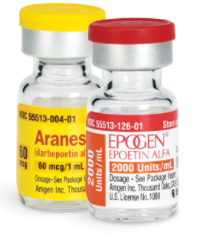
Indications
ARANESP® (darbepoetin alfa) is indicated for the treatment of anemia due to chronic kidney disease (CKD), including patients on dialysis and patients not on dialysis.
EPOGEN® (epoetin alfa) is indicated for the treatment of anemia due to chronic kidney disease (CKD) in patients on dialysis to decrease the need for READ MORE
EPOGEN® (epoetin alfa) is indicated for the treatment of anemia due to chronic kidney disease (CKD) in patients on dialysis to decrease the need for red blood cell (RBC) transfusion.
Limitations of Use:


Amgen ESAs are well-studied
and a proven
option for patients
with anemia due to
CKD1,2

of Amgen ESAs
distributed to
date3,*

treated in real-world
settings4,5,†
*Distribution in the United States in the postmarketing setting from April 1, 2018 through December 31, 2020.
†Combined data for EPOGEN® and ARANESP® in the postmarketing setting from launch through December 31, 2020. For EPOGEN®, data on incident and prevalent number of patients on dialysis and market share are used to estimate number of patients exposed. For ARANESP®, the number of patients exposed are based on sales revenue data.
ESAs = erythropoiesis-stimulating agents; HCPs = healthcare providers; Hb = hemoglobin.
Pioneering research by Amgen led to the development of ESAs, which are specifically designed to treat anemia due to CKD.1,2
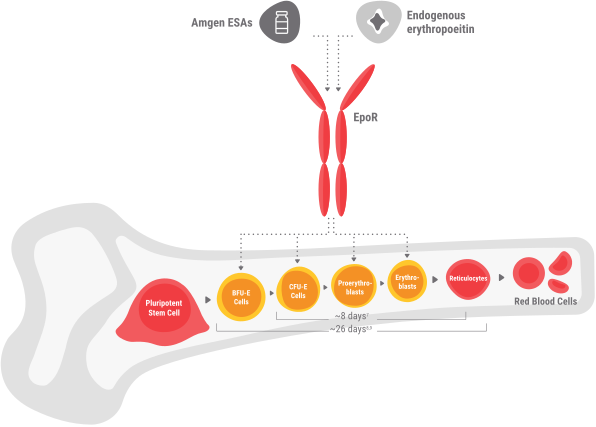
BFU-E = burst-forming unit-erythroid; CFU-E = colony-forming unit-erythroid; EpoR =
erythropoeitin receptor.
Mean monthly Hb among ARANESP® and EPOGEN® patients10,*
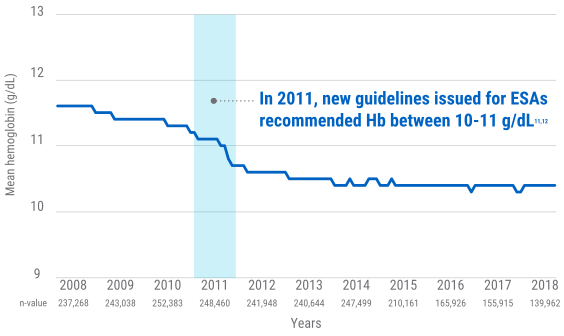
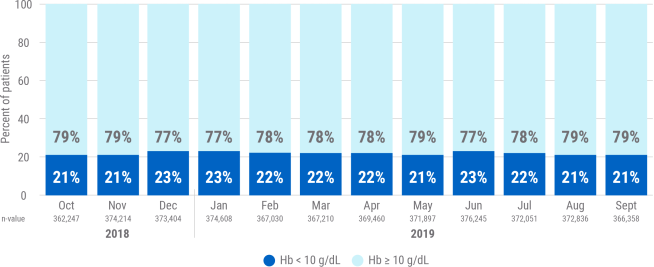
Data are derived from real-world sources and not from a controlled clinical study. Analysis is exploratory and has not been adjusted for multiple comparisons. No conclusion of statistical or clinical significance can be drawn.
*Data from users of either EPOGEN® or ARANESP® were ascertained from Medicare claims in the United States Renal Data System (USRDS) Standard Analysis Files between January 2008 to December 2018. For each calendar month, all Medicare Part B claims in the USRDS Standard Analysis Files were collected. EPOGEN® use was defined by claims including Healthcare Common Procedure Coding System (HCPCS) codes J0885 and Q4081, whereas ARANESP® use was defined by claims including HCPCS codes J0881 and J0882. If more than one hemoglobin measurement was reported in a single month, the mean of all measurements was estimated.10
†Data from 13 clinical studies involving IV administration of EPOGEN® to 1010 anemic adult patients on dialysis. Starting doses were 50 to 150 Units/kg TIW. In the 3 largest studies, the median maintenance dose necessary to maintain the Hb between 10 and 12 g/dL was approximately 75 Units/kg TIW.1
‡Data from a multicenter, randomized, open-label study comparing epoetin, given 1, 2, or 3 times weekly IV or SC, with ARANESP®, at a reduced dose frequency, in dialysis patients (N = 522). Dose adjustments were made as necessary and per study protocol to maintain individual patients’ Hb within a target range of –1.0 to +1.5 g/dL of their baseline Hb and between 9 g/dL and 13 g/dL for up to 52 weeks. The primary endpoint was the change in Hb between baseline and the evaluation period at weeks 25 to 32 of treatment. The mean change in Hb from baseline to the evaluation period was similar in the ARANESP® and epoetin groups, and the difference between the two treatment groups was 0.03 g/dL. This was not a statistically significant or clinically relevant difference. 97% (178/183) of patients’ Hb levels were successfully maintained on ARANESP® QW or less after conversion from epoetin during the evaluation period.13
TIW = three times a week; IV = intravenous; SC = subcutaneous; QW = once weekly.
Mean monthly Hb and mean weekly ARANESP® dose10
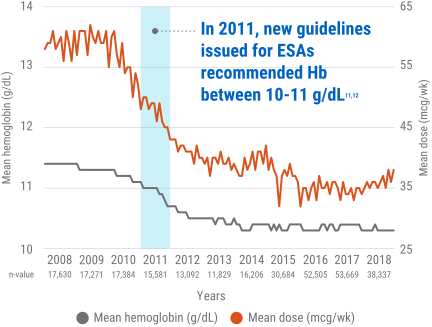
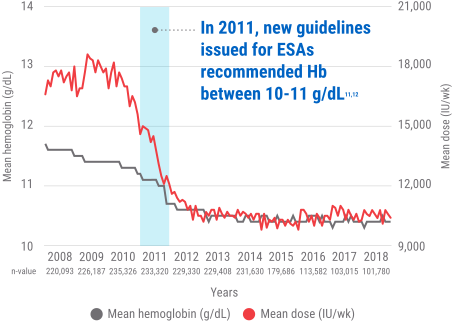
Mean monthly Hb and mean weekly EPOGEN® dose10
Percent of patients by ARANESP® dose (mcg/wk)10
| 2008 n = 17,630 | 2018 n = 38,337 | |
| < 60 mcg/wk | 67.3% | 82.5% |
| 60-99 mcg/wk | 16.3% | 11.5% |
| ≥ 100 mcg/wk | 16.5% | 6.0% |
| Average dose | 59.0 mcg/wk | 36.1 mcg/wk |
Percent of patients by EPOGEN® dose (IU/wk)10
| 2008 n = 220,093 | 2018 n = 101,780 | |
| < 25,000 lU/wk | 78.0% | 93.3% |
| 25,000-49,999 IU/wk | 15.5% | 6.0% |
| ≥ 50,000 IU/wk | 6.5% | 0.7% |
| Average dose | 17,384 IU/wk | 10,550 IU/wk |
*Data from users of either EPOGEN® or ARANESP® were ascertained from Medicare claims in the USRDS Standard Analysis Files between January 2008 to December 2018. For each calendar month, all Medicare Part B claims in the USRDS Standard Analysis Files were collected. EPOGEN® use was defined by claims including Healthcare Common Procedure Coding System (HCPCS) codes J0885 and Q4081, whereas ARANESP® use was defined by claims including HCPCS codes J0881 and J0882. If more than one hemoglobin measurement was reported in a single month, the mean of all measurements was estimated. The cumulative weekly dose of each ESA was derived by dividing the cumulative monthly dose by the number of calendar days in the month, and subsequently multiplying that quotient by 7.10
Percent of patients with Hb < 10 g/dL and ≥ 10 g/dL10
Average percent of patients experiencing consecutive months with Hb < 10
g/dL10,†
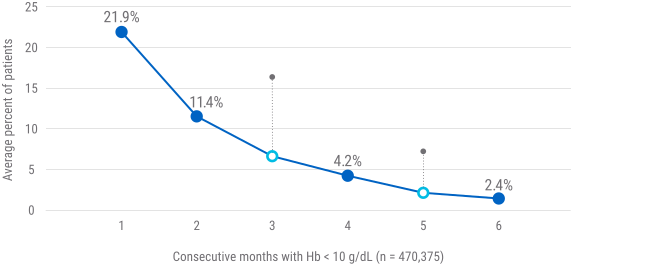
Data are derived from real-world sources and not from a controlled clinical study. Analysis is exploratory and has not been adjusted for multiple comparisons. No conclusion of statistical or clinical significance can be drawn.

INFLAMMATION

IRON DEFICIENCY

BLEEDING

INFECTION
Individualized anemia management and well-established protocols1,2,*

Multiple dosing options (single-dose vials and prefilled syringes)2
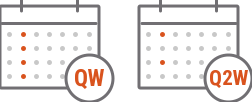
QW or Q2W administration2

Multiple dosing options (single-dose vials and multidose vials)1

TIW administration1
*The IV route of administration is recommended for adult patients on hemodialysis.
†Only available as prefilled syringe.
Q2W = once every 2 weeks.
References:
ARANESP® (darbepoetin alfa) and EPOGEN® (epoetin alfa) Important Safety Information, including Boxed WARNINGS
WARNING: ESAs INCREASE THE RISK OF DEATH, MYOCARDIAL INFARCTION, STROKE, VENOUS THROMBOEMBOLISM, THROMBOSIS OF VASCULAR ACCESS AND TUMOR PROGRESSION OR RECURRENCE
Chronic Kidney Disease:
Cancer:
Perisurgery (EPOGEN®):
Please see ARANESP® full Prescribing Information, including Boxed WARNINGS and Medication Guide.
Please see EPOGEN® full Prescribing Information, including Boxed WARNINGS and Medication Guide.

ARANESP® (darbepoetin alfa) and EPOGEN® (epoetin alfa) Important Safety Information, including Boxed WARNINGS
WARNING: ESAs INCREASE THE RISK OF DEATH, MYOCARDIAL INFARCTION, STROKE, VENOUS THROMBOEMBOLISM, THROMBOSIS OF VASCULAR ACCESS AND TUMOR PROGRESSION OR RECURRENCE
Chronic Kidney Disease:
Cancer:
Perisurgery (EPOGEN®):
Please see ARANESP® full Prescribing Information, including Boxed WARNINGS and Medication Guide.
Please see EPOGEN® full Prescribing Information, including Boxed WARNINGS and Medication Guide.